" height="21.67500002336502px" id="GsCWlry0t" transform="translate(60.5 11.5)" width="69.57400012207032px"/><path d="M 22.432 0 C 22.432 2.955 21.852 5.88 20.724 8.61 C 19.598 11.339 17.946 13.819 15.862 15.91 C 13.781 17.998 11.308 19.655 8.585 20.787 C 5.864 21.918 2.947 22.5 0 22.5 L 0 0 L 22.43 0 Z" fill="rgb(59, 76, 255)" height="22.5px" id="s1UzGfaC9" transform="translate(22.5 22.5)" width="22.43199999999979px"/><path d="M 6.57 38.41 C 2.361 34.185 -0.002 28.464 0 22.5 C 0 16.533 2.363 10.81 6.57 6.59 C 10.771 2.373 16.478 0.002 22.43 0 C 28.38 0 34.085 2.37 38.292 6.59 L 22.431 22.5 Z" fill="rgb(59, 76, 255)" height="38.41px" id="WrlFnrcj0" width="38.29200073579659px"/></g></svg>)

Mike Fritschner
Finance-First Marketplace Operations: Why Visibility Is Now a Competitive Advantage
Finance-First Marketplace Operations: Why Visibility Is Now a Competitive Advantage

Most financial systems today weren’t built for how e-commerce actually operates.
As companies expand across marketplaces like Amazon, Walmart, and Shopify, revenue grows, but so does complexity. Each channel brings different fee structures, payment terms, return behaviors, and payout mechanics. The result:
Reported performance and actual profitability begin to diverge.
From an FP&A perspective, this shows up consistently:
Hidden costs eroding margin
Difficulty comparing performance across channels
Ongoing reliance on manual, aggregate reconciliation
At scale, that breaks down. Profitability is determined at the line-item level, not in summary reports.
This is where we’re seeing a shift toward a more finance-first operating model, enabled by platforms like Gierd.
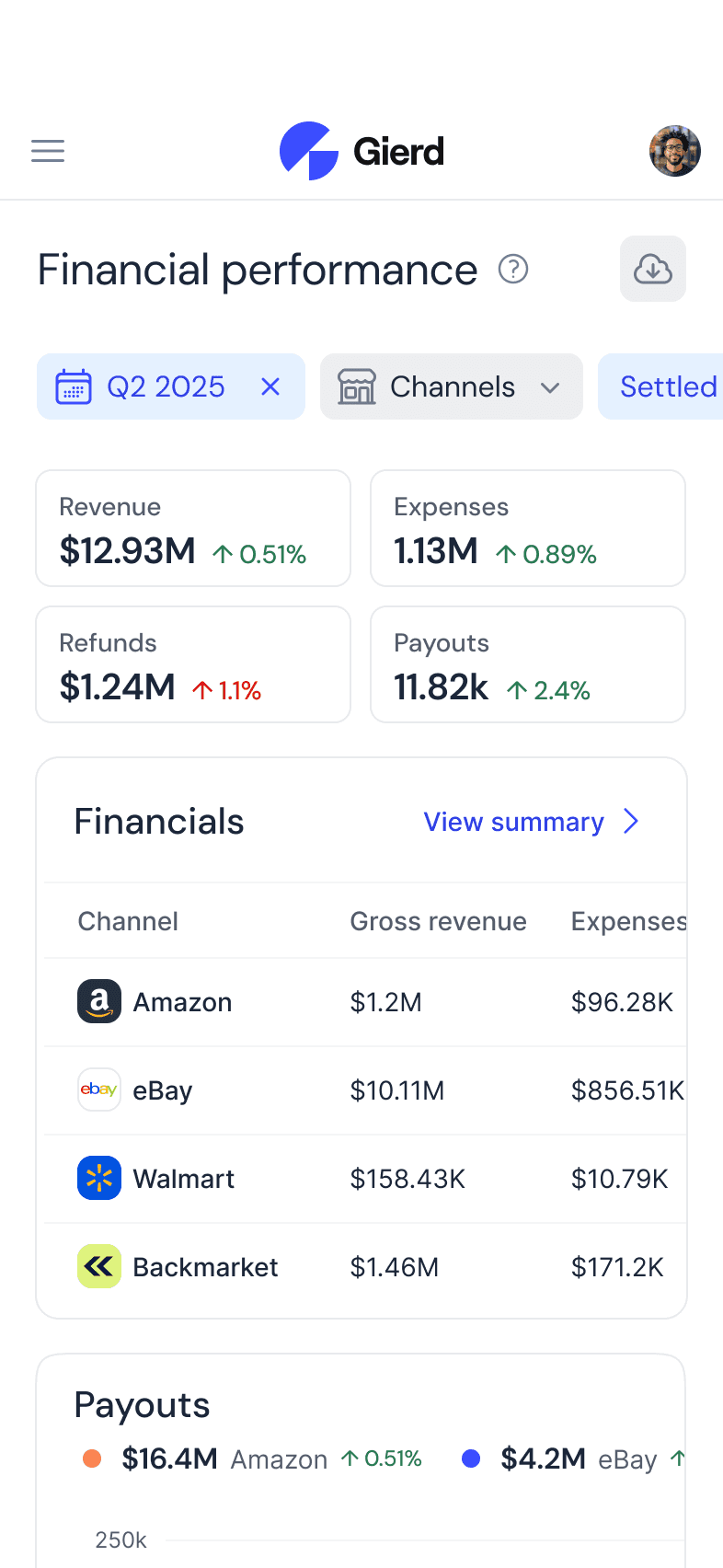
Gierd automates reconciliation across marketplaces, ERPs, and banks, structuring activity into a unified commerce ledger that links transaction → payout → cash, with full visibility into every revenue and cost driver.
In practice, this brings together what is typically fragmented.
Across marketplaces, I’ve seen how variations in payment terms, fee structures, return rates/processes, and order-level fees - combined with advertising and marketing spend - materially impact profitability. Viewed separately, these are manageable. Together, they often obscure true performance.
Gierd consolidates these drivers into a single view, allowing teams to understand true SKU-level profitability, not just on the sale, but across the full lifecycle, including costs that are often missed or misallocated.
The impact is a shift in how finance operates.
Teams can:
Identify margin leakage in near real time
Compare marketplaces on a true like-for-like basis
Make better tradeoffs between margin, volume, and inventory aging
In my experience, this also removes a common friction point, less time reconciling numbers, more time aligning on decisions.
As marketplace complexity continues to increase, this level of visibility is becoming less of an advantage and more of a requirement.
The question is no longer whether finance can close the books - it’s whether finance has the visibility to run the business effectively.
Most financial systems today weren’t built for how e-commerce actually operates.
As companies expand across marketplaces like Amazon, Walmart, and Shopify, revenue grows, but so does complexity. Each channel brings different fee structures, payment terms, return behaviors, and payout mechanics. The result:
Reported performance and actual profitability begin to diverge.
From an FP&A perspective, this shows up consistently:
Hidden costs eroding margin
Difficulty comparing performance across channels
Ongoing reliance on manual, aggregate reconciliation
At scale, that breaks down. Profitability is determined at the line-item level, not in summary reports.
This is where we’re seeing a shift toward a more finance-first operating model, enabled by platforms like Gierd.
Gierd automates reconciliation across marketplaces, ERPs, and banks, structuring activity into a unified commerce ledger that links transaction → payout → cash, with full visibility into every revenue and cost driver.
In practice, this brings together what is typically fragmented.
Across marketplaces, I’ve seen how variations in payment terms, fee structures, return rates/processes, and order-level fees - combined with advertising and marketing spend - materially impact profitability. Viewed separately, these are manageable. Together, they often obscure true performance.
Gierd consolidates these drivers into a single view, allowing teams to understand true SKU-level profitability, not just on the sale, but across the full lifecycle, including costs that are often missed or misallocated.
The impact is a shift in how finance operates.
Teams can:
Identify margin leakage in near real time
Compare marketplaces on a true like-for-like basis
Make better tradeoffs between margin, volume, and inventory aging
In my experience, this also removes a common friction point, less time reconciling numbers, more time aligning on decisions.
As marketplace complexity continues to increase, this level of visibility is becoming less of an advantage and more of a requirement.
The question is no longer whether finance can close the books - it’s whether finance has the visibility to run the business effectively.
Strategy & Tactics
Why Wait? Start Smarter Marketplace Growth Today!
Why Wait? Start Smarter Marketplace Growth Today!







Why Wait? Start Smarter Marketplace Growth Today!
Smarter Marketplace Commerce.
Unstoppable Growth.


•
120 East Lake Street, Suite 401, Sandpoint, ID 83864, USA
•
Smarter Marketplace Commerce.
Unstoppable Growth.
120 East Lake Street, Suite 401, Sandpoint, ID 83864, USA